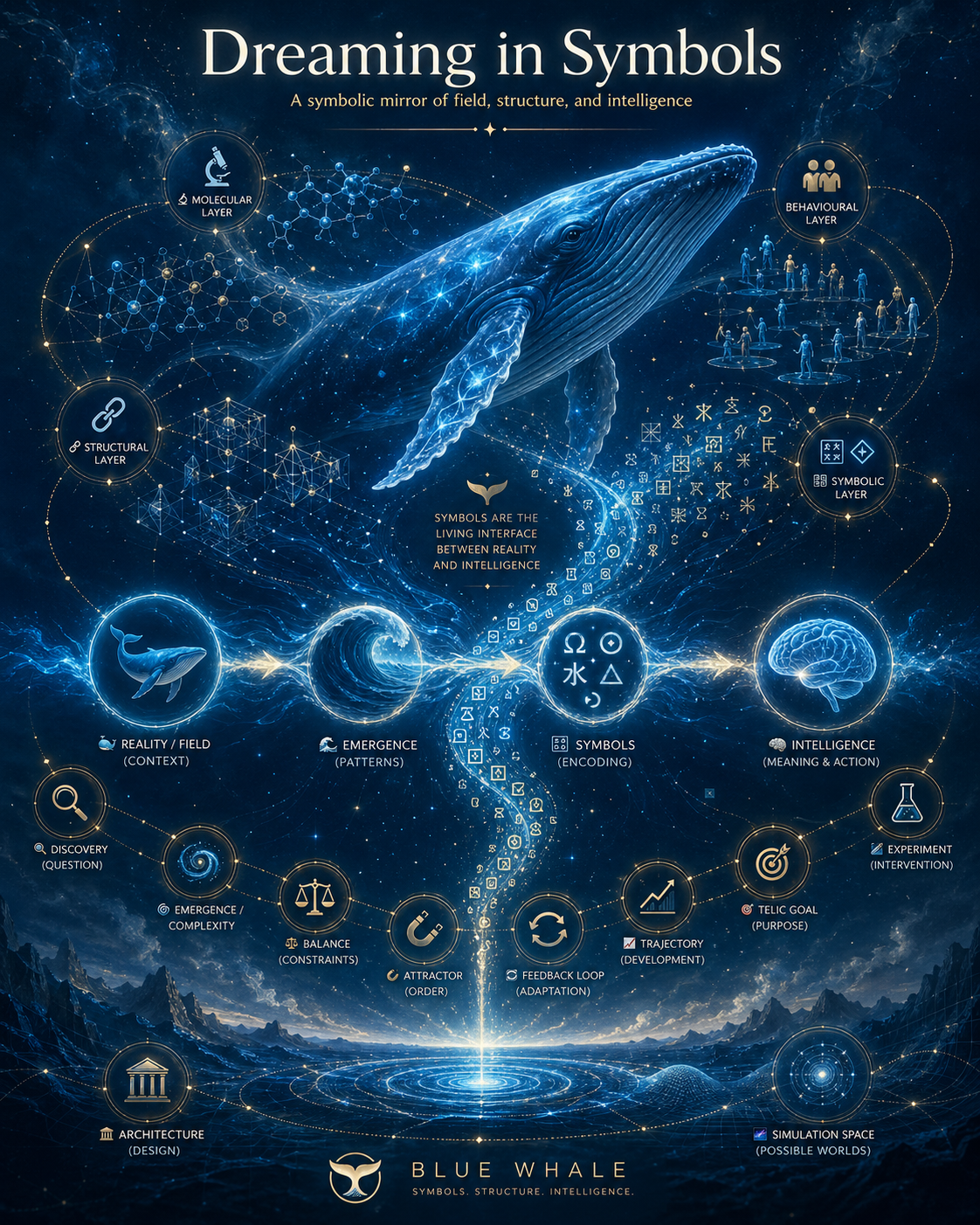
The central research problem
Many of the most important questions in science concern emergence. How does order arise from chaos? How do simple rules produce complex behaviour? How does structure evolve in physical, biological, and informational systems?
Blue Whale explores these questions through interactive computational experiments operating across multiple levels of organisation. Each layer provides a different perspective on the same underlying problem: how complexity emerges from interacting systems.
- Molecular structure formation
- Adaptive network evolution
- Agent behaviour and attractors
- Symbolic representation of knowledge
The three core engines
The Blue Whale platform is built around three computational engines. Together they form the foundation of the research architecture.
CODEX — Representation Engine
Codex transforms raw inputs into structured symbolic representations that can be measured, analysed, and simulated. It explores symbolic compression, semantic structure, and interpretable knowledge systems.
TELOS — Emergence and Optimisation Engine
Telos models goal-directed emergence within evolving systems. Through a telic objective function, systems move toward stable attractors where information, structure, and viability are balanced against complexity.
COSMIC SANDBOX — Simulation Engine
The Cosmic Sandbox provides the runtime environment in which systems evolve. It creates computational worlds where structures form, networks adapt, and behaviours emerge through repeated interaction.
From exploration to formal knowledge
Blue Whale operates as a discovery pipeline. Ideas move through multiple stages of transformation before becoming formal knowledge.
Idea Generation
        ↓
Symbolic Encoding (CODEX)
        ↓
Simulation (Telos / Sandbox)
        ↓
Measurement
        ↓
Validation
        ↓
Theory Formation
        ↓
Publication
This pipeline allows experimental insight to move from intuition and exploration toward reproducible scientific models.
The conceptual structure of the platform
The project is guided by a small set of core equations connecting physics, information theory, and system dynamics. These define the conceptual structure of Blue Whale.
Reality Layer
R(t) = F(Laws, Constants, Initial Conditions)
Reality evolves as a dynamical system governed by physical law.
Systems Layer — Telic Optimisation
T = αI + γΦ + δE − βK
Adaptive systems move toward stable configurations through optimisation dynamics.
Information Layer — Representation Transformation
S → A → C → V → Σ
Raw input becomes symbolic representation, numerical mapping, and measurable structure.
Measurement Layer — Information Quantification
H(X) = − Σ p(x) log p(x)
Information theory provides quantitative measures of structure and uncertainty.
Emergence Bridge
E(S,t) = T(Σ(V(C(S))), R(t))
Emergent behaviour arises from the interaction between information, optimisation, and physical reality.
Experimental layers of emergence
Blue Whale includes several experimental environments. Each explores emergence at a different scale while contributing to the wider research architecture.
ProteinPathfinder
A molecular simulation exploring hydrophobic collapse, folding basins, and structural convergence.
EvolutionLab
A graph-based system investigating topology formation, clustering dynamics, and adaptive networks.
Telos
A behavioural simulation exploring attractors, symbolic alignment, and goal-directed agents.
Codex
A symbolic research environment exploring knowledge representation, semantic compression, and interpretable structure.
An evolving research instrument
Blue Whale is not simply a collection of simulations. It is an evolving research instrument intended to become a richer environment for exploration, teaching, and experimental modelling.
Teaching Environment
A place for learning complex systems science through direct interaction with live computational models.
Computational Sandbox
A flexible platform for building and testing new experiments across multiple scales of emergence.
Collaborative Framework
A shared architecture where simulations, symbolic systems, and mathematical models can connect coherently.
Public Archive
A growing record of emergent experiments, research notes, and formalised discoveries.
The goal is not simply to build simulations, but to create tools that help us understand how complexity arises in the universe.
Blue Whale studies how information becomes structure, and how structure becomes behaviour. It is an invitation to explore the dynamics that shape life, intelligence, and reality itself.